Bloks. The Un-CRM.
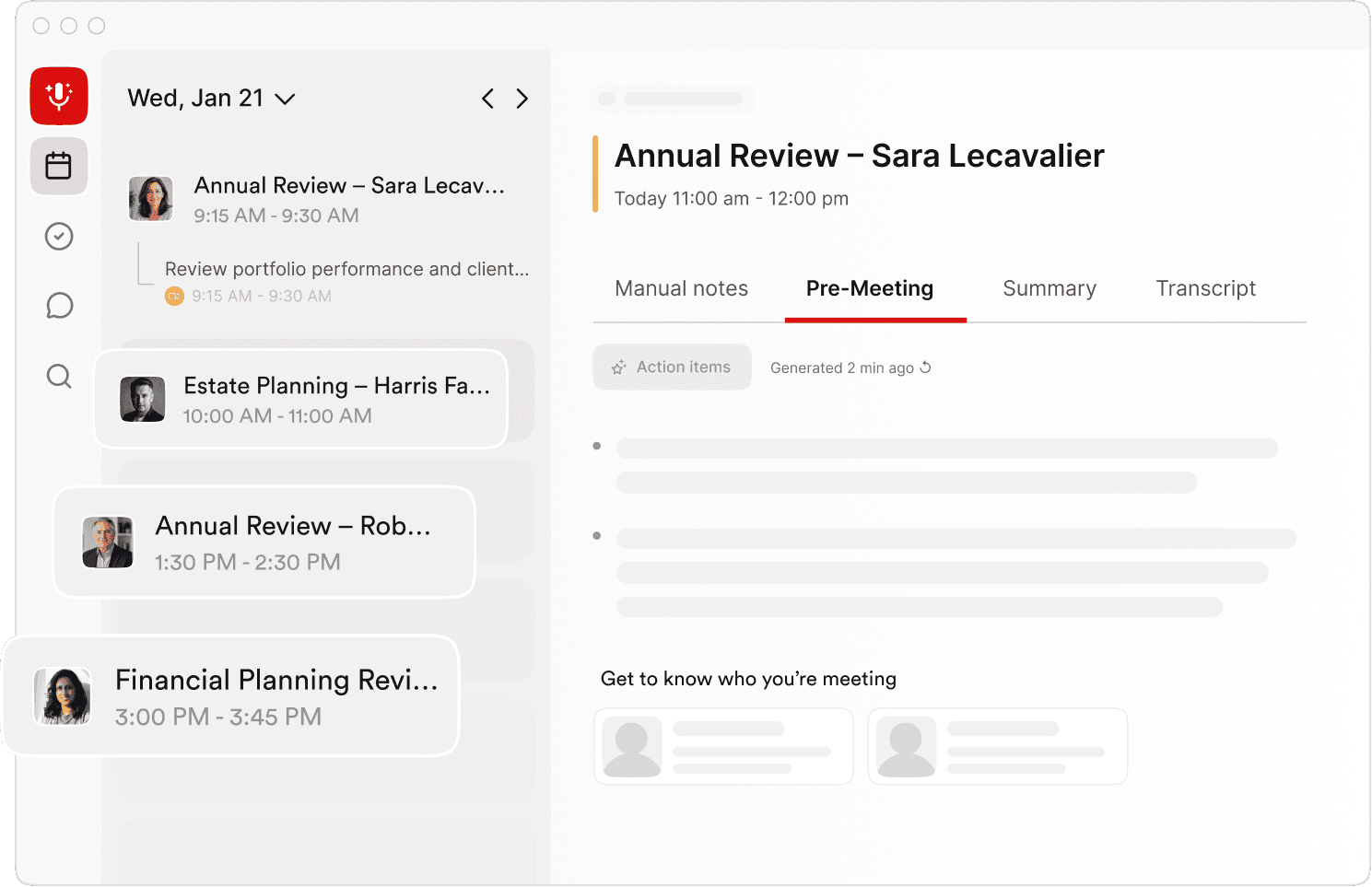
Client Follow-Up That Starts Before You Leave the Meeting
Client follow-up fails in the gap between the conversation and the keyboard. Every CRM for financial advisors waits there. A financial advisor promises something at minute forty. The client meeting runs long. The next client waits. By evening the promise is a vague feeling that something was owed.
Bloks removes the gap. The AI notetaker for financial advisors understands the client conversation as it happens, and the follow-up chain starts from that capture, not your memory. No note-taking, no meeting prep, no transcripts to reread.
That is the whole design. Nothing gets remembered. Everything gets caught, automatically.
From Spoken Commitment to Assigned Task With a Due Date
A commitment is specific: someone owes someone an action by a date. Bloks reads client conversations for that shape and produces structured tasks, not a highlighted transcript line.
Follow-up tasks arrive with four fields already populated:
- The action item, written as an instruction rather than a quote
- The assignee, matched to the advisor or team member who owns it
- The due dates agreed in the meeting, not guessed afterwards
- The client record it belongs to, so nothing floats loose
Custom fields carry through where your advisory practice uses them, whatever the meeting type. Advisors who automate their documentation stop rebuilding action items from memory an hour later, which is exactly when admin time turns into evening work.
Nothing falls through the cracks, because nothing depends on anyone remembering.
Follow-Up Emails Drafted From the Conversation, Not a Template
Templates say the same thing to every client. A personalized follow-up email citing the RESP contribution room you discussed says something only you could write.
Bloks drafts recap emails from the client conversation itself. The follow-up email quotes the decisions made, the numbers agreed, and the next steps promised, in your register rather than a generic house style. You read the recap email, adjust a line, send it. Two minutes, not twenty.
One capture feeds every artifact, so the client email, the meeting notes, and the follow-up tasks all agree with each other. Advisors who turn conversations into client emails send the same afternoon rather than the following week, and client experience improves for the plainest possible reason: the client hears back.
and send — not twenty
What Follow-Up Software Has to Do Beyond Drafting an Email
- Capture
- Assignment
- Tracking
- Completion
Plenty of financial advisor software writes the email. Far fewer track what happens next. Following up is the part that breaks.
Follow-up software earns its place when it owns the full arc: capture, assignment, tracking, completion, and the client record that proves all four happened. Drafting is the easy quarter of the job. The hard part is the week after, when six clients are each waiting on something different and no single person holds the whole pipeline of open follow-ups.
Bloks handles that arc as one layer, not a stack of integrations you maintain. You can see how Bloks works, feature by feature for the full picture of what sits underneath.
Every Follow-Up Has an Owner, a Status, and an End State
are rarely forgotten.
They are usually
unowned.
An action item without an owner is a wish. Bloks assigns every follow-up to a person, gives it a status, and keeps it visible on your dashboards until that status changes to done.
Status is the part most task management tools skip. A task in a list is not a task somebody is accountable for. The difference surfaces three weeks later, when the client asks why nobody called. Missed follow-ups are rarely forgotten. They are usually unowned.
Team members see each other's queues and deadlines without a reporting request. An advisor hands a task to an assistant without a hallway conversation, and the assistant gets the context behind it, not just the instruction. Workflows stay visible across the practice rather than inside one inbox.
Follow-Ups From Calls, Emails, and In-Person Conversations Too
Commitments are not made only on video calls. Advisors make them at kitchen tables, in cars, on mobile calls between appointments, and across the long client emails that follow an annual review.
- Video calls: Teams, Zoom, Google Meet, Webex
- In-person meetings, no bot required
- Mobile calls between appointments
- Client emails via Outlook or Microsoft 365
Bloks understands all of it. Client meetings on Microsoft Teams, Zoom, Google Meet, and Webex are covered without a bot joining the call, and in-person client meetings and mobile conversations produce the same structured follow-ups, summaries, and tasks. The AI meeting assistant for financial advisors page covers that intelligence layer in detail.
Email counts too. Connect Outlook or Microsoft 365 and a promise made in a reply becomes a tracked follow-up task the same way a spoken one does.
Start Your Free Trial and Clear the Follow-Up Backlog
Fourteen days, every feature, nothing to configure. Your next client conversation is captured before you finish reading the welcome email.
Follow-Up Tasks Your Whole Team Can See and Act On
Most follow-up tools help one advisor remember one client meeting. That is a personal efficiency fix, and it stops working the moment a practice grows past one person. Bloks tracks commitments across the whole team. The advisor makes the promise. The assistant sees the follow-up task, owns it, closes it. The managing partner sees which client relationships have something outstanding without asking. Practice management stops depending on individual memory. Shared context across client-facing teams is what turns personal follow-up into practice-wide follow-through.
When the Assistant Acts on What the Advisor Promised
Your assistant should not have to ask what happened in the meeting. With their own license, an assistant sees the client record, the open follow-ups, and the reasoning behind each task. The work moves without a briefing. Client service gets faster because nobody is waiting for a handover.
That matters more than it sounds. When context lives in one advisor's head it leaves when they do, and the hidden cost of context loss shows up during a succession or a book transfer. Shared client records make the practice, not the person, the unit of continuity. Client retention follows from that continuity more reliably than from any single relationship.
Assistants get a dedicated seat rather than a shared login. See advisor and assistant pricing for how the licences work.
Ask Bloks Which Commitments Are Still Open Across Your Book of Business
Ask Bloks answers questions about your book of business in plain language. Which clients are waiting on something from me? Who did I promise a policy review to last quarter? Which prospects never got a follow up email after the discovery call?
Answers come from your own client histories, not the open internet, and each cites its source, so you can open the client meeting behind it. Using conversational AI across client histories turns a book you half-remember into one you can query.
Ask it before an annual review or a financial needs analysis. Ask it on a Friday afternoon when you want every outstanding touchpoint in one list. It surfaces life events, referral openings, retirement planning triggers, and check-ins nobody scheduled.
Follow-Up Records Canadian Financial Advisors Can Defend
Compliance is where follow-up stops being a productivity question. A regulator does not ask whether you remembered. It asks what was agreed, when, and what you did about it.
Most follow-up systems produce tasks. Very few produce compliant evidence. Bloks produces both from one capture. The record holds up under review instead of needing reconstruction the week before an audit.
Every Commitment Traceable to the Conversation That Created It
Every follow-up task, draft, and generated document in Bloks points back to the client conversation that produced it. Time-stamped, retained, and reviewable, with a complete audit trail behind each one.
That traceability is the whole compliance argument. A KYP letter assembled from the same source as the meeting notes cannot drift from them, and documentation built this way stays consistent across every client and every advisor. Inconsistent records are a compliance risk long before they become an audit finding. Pulling KYC data and client data into one current picture, as covered in unifying KYC and CRM, keeps the paperwork defensible without adding a step to your day.
Retention rules are yours to configure. So is who sees what, and what Bloks moves to archive and when. Document management stops being a separate job.
PIPEDA, Canadian Data Residency, and SOC 2 Type II, Applied to Follow-Ups
Bloks is SOC 2 Type II certified, PIPEDA compliant, and hosts client data in Canada. U.S. compliance is supported for advisors working across the border, and the product and support team both operate in French for advisors in Quebec. Applied to follow-ups, that control set means four specific things:
- Encryption at rest and in transit covers every follow-up, draft, and document
- Client consent is collected by email or in-meeting prompt, never mid-conversation
- Your client data is never used to train AI models, and stays secure in Canada
- Audit trails, TCPA consent records, and retention rules cover the follow-up chain, not the meeting notes alone
Advisors working this through in detail should read the privacy-first advisor. Compliance officers ask about security architecture, encryption, and archiving partners like Global Relay or Hadrius first. Every answer is documented.
Talk to Bloks About Compliant Follow-Up in Canada
Bring your compliance questions, not only your calendar. Fifteen minutes covers Canadian data residency, client consent, and retention with your team.
People, not paperwork. The follow-up record is a by-product of the conversation, not a second job.
Works With the Financial Advisor CRM You Already Use
You do not have to move anything. Bloks runs standalone or alongside the financial advisor CRM your practice depends on, keeping it current from the conversation, not your typing. That inversion is what the Un-CRM means in practice.
Follow-Up Tasks Synced to Laylah, Salesforce, Wealthbox and Equisoft
A CRM is only as good as its last update, which is why CRMs fail without consistent data no matter how good the platform around it is. Bloks removes the dependency on someone typing. Ask our team about coverage for Redtail, Advyzon, eMoney, Orion, PreciseFP, or Practifi before you start a free trial.
as its last update.
CRM sync is confirmed for Laylah, Salesforce, Wealthbox, and Equisoft. Follow-up tasks land in the CRM platform your team already opens, synchronized to the fields it expects, with no data entry and no migration project. Contact management, client records, the opportunity pipeline, and task management all stay current on their own.
Automated Follow-Up, Starting With Your Next Conversation
Automated follow-up should feel like nothing changed, except the evenings. You run the client meeting the way you always have. The follow-up tasks, drafts, and records assemble behind it. The admin work that used to follow every client interaction stops arriving.
That is the narrow claim. For the wider stack, our guide to AI tools for financial advisors covers where client follow-up software sits.
No Setup, No Follow-Up System to Configure
If AI in a regulated practice feels like a large step, a real person from our team walks you through it live, at your pace. You will probably never need us. We are here anyway.
never need us.
We are here anyway.
There is no follow-up system to build. No workflow automation to design, no fields to map, no onboarding week, no integrations to wire through Zapier or Slack. Bloks starts capturing from your first client meeting. An AI assistant that needs configuring is not saving anyone time.